 Water Treatment Market
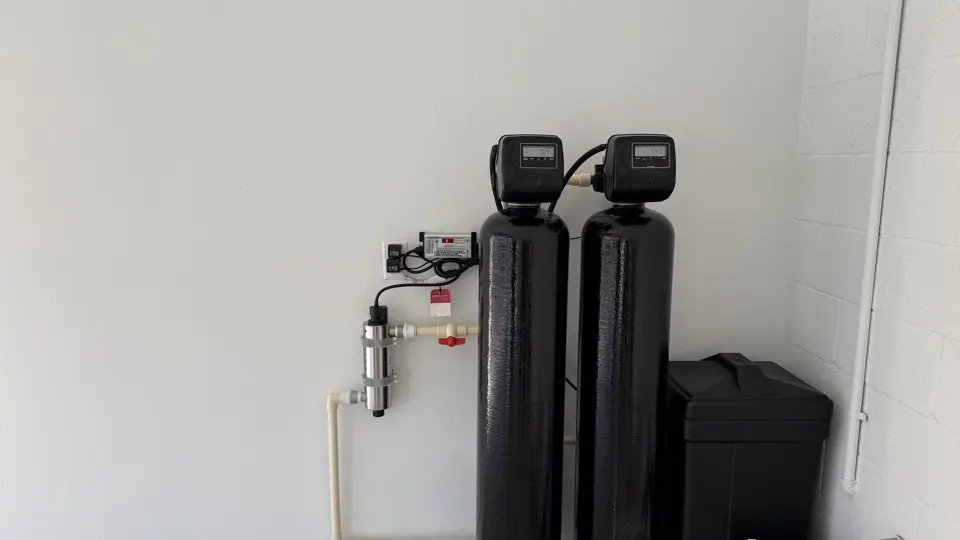
1. Why the lamp is on a schedule
VIQUA rates its UV lamp at an effective life of approximately 9,000 hours of continuous operation — about one year — and instructs owners to replace it annually to ensure adequate performance (a seasonal home on part-year use may go every second year, per the same manual). The lamp usually still glows blue at the end of that year; what has dropped is the invisible ultraviolet output the water is counting on. The controller counts the days down from 365 and sounds an end-of-life alarm at zero. That alarm can be deferred four times, seven days each, to buy time to get a lamp — after the fourth deferral it can only be silenced by changing the lamp and resetting the timer. Treat the alarm as the last reminder, not the first.
2. The parts, by the manual’s own numbers
The worked example on this page is the VIQUA VH410 family — the plain VH410, its monitored VH410M version, and the VH410-F20 model with a built-in filter housing. The manual’s parts table gives:
- UV lamp: S410RL-HO (the whole VH410 family, including the F20).
- Quartz sleeve: QSO-410.
- O-ring: 410867, used on all systems in the line.
- Retaining (gland) nut: RN-001; spring: SP008; lamp connector base: 270276-R.
- Controller: BA-ICE-CL.
- On the VH410-F20 only, the built-in sediment cartridge is CMB-520-HF (20-inch, 5 micron), and the manual recommends changing the filter cartridge every six months — sooner if pressure drops, which is the sign of a clogging cartridge.
VIQUA’s warning about copy lamps is blunt: non-genuine lamps have been shown to damage the control module, the damage is not covered by warranty, and on a system without a UV sensor there is no way to verify a substitute lamp’s invisible output. A lamp that lights up is not proof of a lamp that disinfects.
3. Safety, before anything is touched
- Always disconnect power before performing any work on the UV system, and always shut off the water flow and release the water pressure before servicing. Let the unit cool for 10 minutes after unplugging — the lamp and chamber are hot.
- Do not use water anywhere in the house during the lamp change.
- Handle the lamp by its ceramic ends only. Skin contact and drops are both hard on a thin glass lamp.
- Never look directly at a lit UV lamp, and never operate the lamp outside the chamber: UV radiation can harm eyes and skin even in small doses.
- The lamp contains mercury. If one breaks, avoid breathing or touching the debris, never use a vacuum cleaner on it — that scatters the mercury — and follow local rules for mercury waste disposal. The manual points owners to lamprecycle.org for lamp disposal generally.
- The system belongs on a properly grounded outlet protected by a ground fault circuit interrupter (GFCI). If water is sitting on parts that should be dry — the controller or the lamp connector — do not plug the system in.
4. The lamp change, in the manual’s order
- Shut off the water line to the chamber and release the system pressure.
- Disconnect the main power source and let the unit cool for 10 minutes.
- Remove the lamp connector by squeezing the plastic locking tabs on the side of the connector.
- Pull the lamp upward out of the chamber, holding it by the ceramic ends.
- Insert the new lamp fully into the chamber, leaving about two inches protruding. The connector fits in only one position, so it cannot be attached backwards.
- Attach the connector to the lamp, then push the lamp connector against the connector base until an audible click is heard.
- Reset the lamp-life timer: hold down the timer reset button while reapplying power, until the display reads 365 again after the audible tone.
- Re-pressurize the system slowly and check for leaks.
5. Cleaning the quartz sleeve
The lamp never touches the water. It sits inside a quartz sleeve, and minerals in the water slowly form a coating on that sleeve. The coating blocks UV light from reaching the water, so the sleeve is cleaned at the same visit as the lamp change — and sooner if the water coats it faster. With the water shut off, the lines drained, and the lamp removed: take off the bottom retaining nut and O-ring, then the top retaining nut, floating spring, and O-ring, and ease the sleeve out of the chamber. Clean it with a cloth soaked in CLR cleaner, vinegar, or another mild acid, then rinse with water. If the sleeve cannot be cleaned completely, or it is scratched or cracked, replace it — a coated or damaged sleeve quietly under-doses every gallon that passes. Reinstall with the sleeve protruding an equal distance at both ends, slide the supplied O-rings onto each end, and rebuild the nuts and spring in reverse order.
6. After service: clean the plumbing, then wait five minutes
The manual requires the plumbing-cleaning procedure after a lamp or sleeve change — and any time the system has been shut down for service, without power, or inoperative for any reason — because the pipes downstream of the unit are no longer protected while it is off. In the manual’s procedure, two cups of household bleach solution (5.25 percent) are poured into the filter sump, the system is refilled, each faucet is run until bleach is smelled, and the bleach then sits in the lines for 30 minutes before every outlet is flushed until the bleach smell is gone — at least five minutes of flushing. Do not drink the water until the flush is complete. Two more of the manual’s rules belong in the same breath: after power is applied — including after a power interruption — do not pass water through the system for a minimum of five minutes, so no under-treated water slips through while the lamp comes up; and after long periods with no flow, the water standing in the chamber can reach roughly 60 degrees Celsius (about 140 degrees Fahrenheit), so run a tap until that hot water is purged before the water touches skin.
7. The water the lamp has to work with
A lamp change does not fix water the light cannot get through. The manual’s recommended water chemistry limits for the system are: iron under 0.3 parts per million (ppm), hardness under 7 grains per gallon (gpg) — 120 milligrams per liter — turbidity under 1 nephelometric turbidity unit (NTU), manganese under 0.05 ppm, tannins under 0.1 ppm, and ultraviolet transmittance (UVT) above 75 percent. Above 7 gpg of hardness the manual says the water should be softened first; below it, the unit works provided the sleeve is cleaned periodically. Flow matters the same way: the VH410’s rated flow is 18 gallons per minute (gpm) at the manufacturer’s standard dose of 30 millijoules per square centimeter, measured at 95 percent UVT with the lamp at end of life. Push water through faster than the rating and each gallon gets less exposure and a lower dose.
Sources
- VIQUA, Owner’s Manual, Models VH200-F10 and VH410-F20 (document 520190-R, Revision N) — opened and read in full for this page, 2026-11-17: lamp life of approximately 9,000 hours and annual replacement (Sections 1 and 4), parts table (lamp S410RL-HO, sleeve QSO-410, O-ring 410867, nut RN-001, spring SP008, controller BA-ICE-CL, cartridge CMB-520-HF), lamp replacement procedure (Section 4.1), quartz sleeve cleaning and replacement (Section 4.2), six-month cartridge interval (Section 4.3), plumbing cleaning procedure (Section 3.2), controller countdown and alarm deferral (Section 5.1), water chemistry limits (Section 1.3), and all safety warnings (Section 1).
- VIQUA, Owner’s Manual, VH, VH-F, and VP Series (document 520585, Revision B) — opened and read for this page, 2026-11-17: the shared parts table confirming lamp S410RL-HO and sleeve QSO-410 across the VH410 family, and the specifications table giving the VH410 a rated flow of 18 gallons per minute at 30 millijoules per square centimeter at 95 percent ultraviolet transmittance, based on end of lamp life (Section 8.1).